
Invoices & receipts
You are the seller; frequentix issues the paperwork on your behalf. Buyers get a receipt or a proper VAT invoice, corrections follow accounting rules rather than edits, and nothing ever disappears.
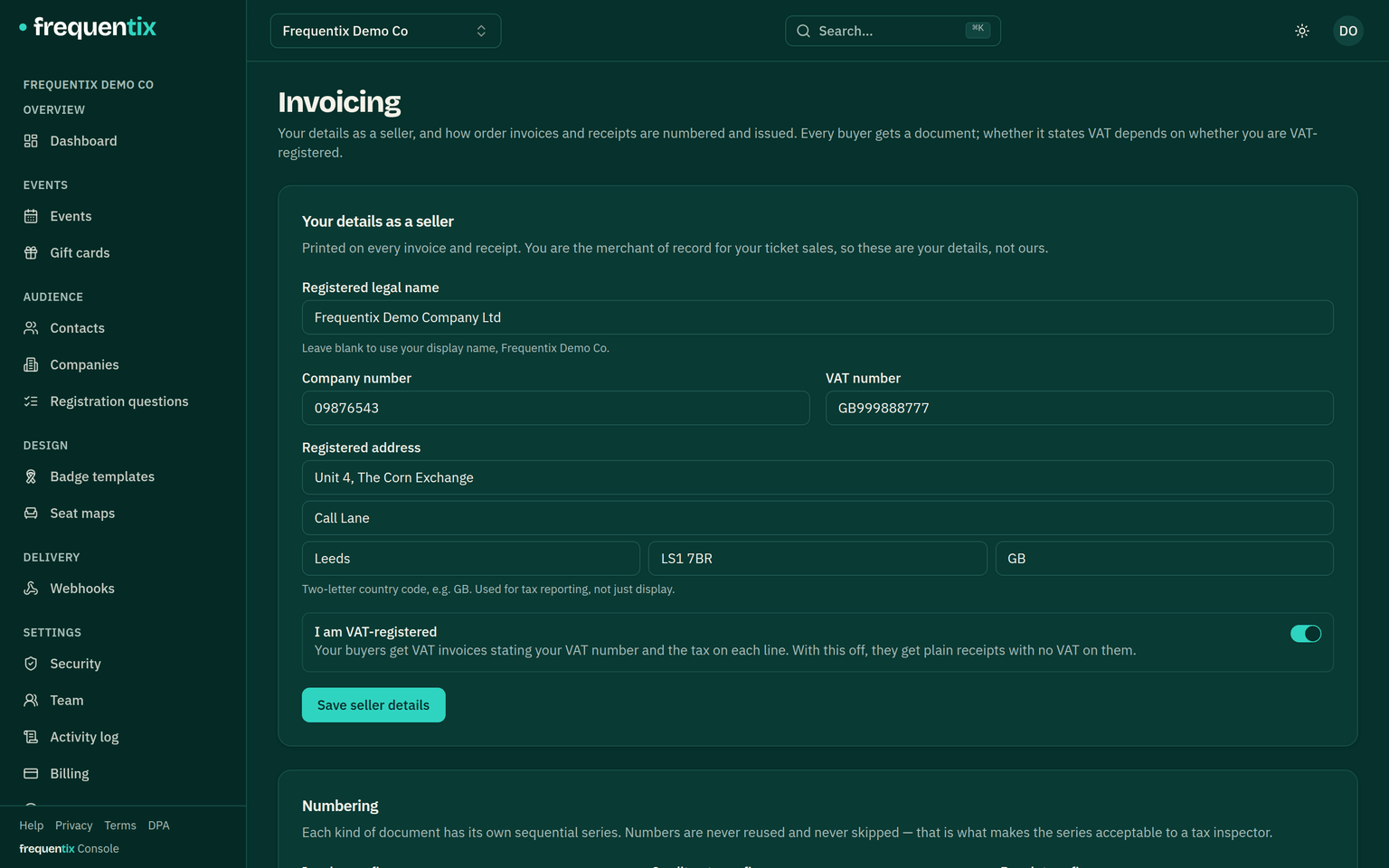
Where to find it: open your event, then Attendees → Invoices in the sidebar. Your organiser-wide numbering and details live under Settings → Invoicing.
Receipt, invoice, credit note
- A receipt — issued when you’re not set up for VAT invoicing. On every plan.
- A VAT invoice — issued once your seller details (VAT number, address, country) are complete in Settings → Invoicing; the console tells you exactly what’s missing. Consumer purchases up to £250 produce a legally simplified invoice with no buyer address needed; above that — or when the buyer supplies company details — a full one issues.
- A credit note — raised automatically when a refund settles.
- A payment request — the pro-forma sent when you request payment by bank transfer (Pro and above). It quotes the same figures the eventual invoice will state, says on its face that it is not a VAT invoice, and is numbered under its own series so your VAT sequence is untouched. The real invoice or receipt issues when you mark the transfer received.
When buyers get which
- By default a document is issued automatically when an order is paid; you can widen that to free orders too, or switch to on-request only.
- The confirmation email carries a link to the document — never an attachment — and the buyer’s order page shows it permanently, as accessible HTML and PDF (invoices also as EN 16931 e-invoice XML, the European standard procurement systems ingest).
- Buyers can add company and VAT details after purchase — the usual moment a business buyer realises they need a full invoice.
- A door sale is documented by the same path as any online order.
- If you pass the platform fee to buyers and opt into booking-fee VAT, the VAT is extracted from inside the fee — the buyer’s total never changes; only how much of it you keep does.
- Online events get no invoices or receipts, automatically or on request. VAT taxes an online admission where each buyer lives rather than where you are, so a document written under the in-person rules would state the wrong tax — asking for one is refused with exactly that explanation, and anything issued before the event was flagged online stays valid and downloadable.
Corrections
Documents are never edited. The document kind is frozen at issue — registering for VAT next year doesn’t rewrite last year’s receipts — and there are exactly two corrections:
- Wrong value (a refund) → a credit note reverses it.
- Wrong identity (buyer supplied company details late) → cancel and reissue, keeping the audit trail.
Numbering & retention
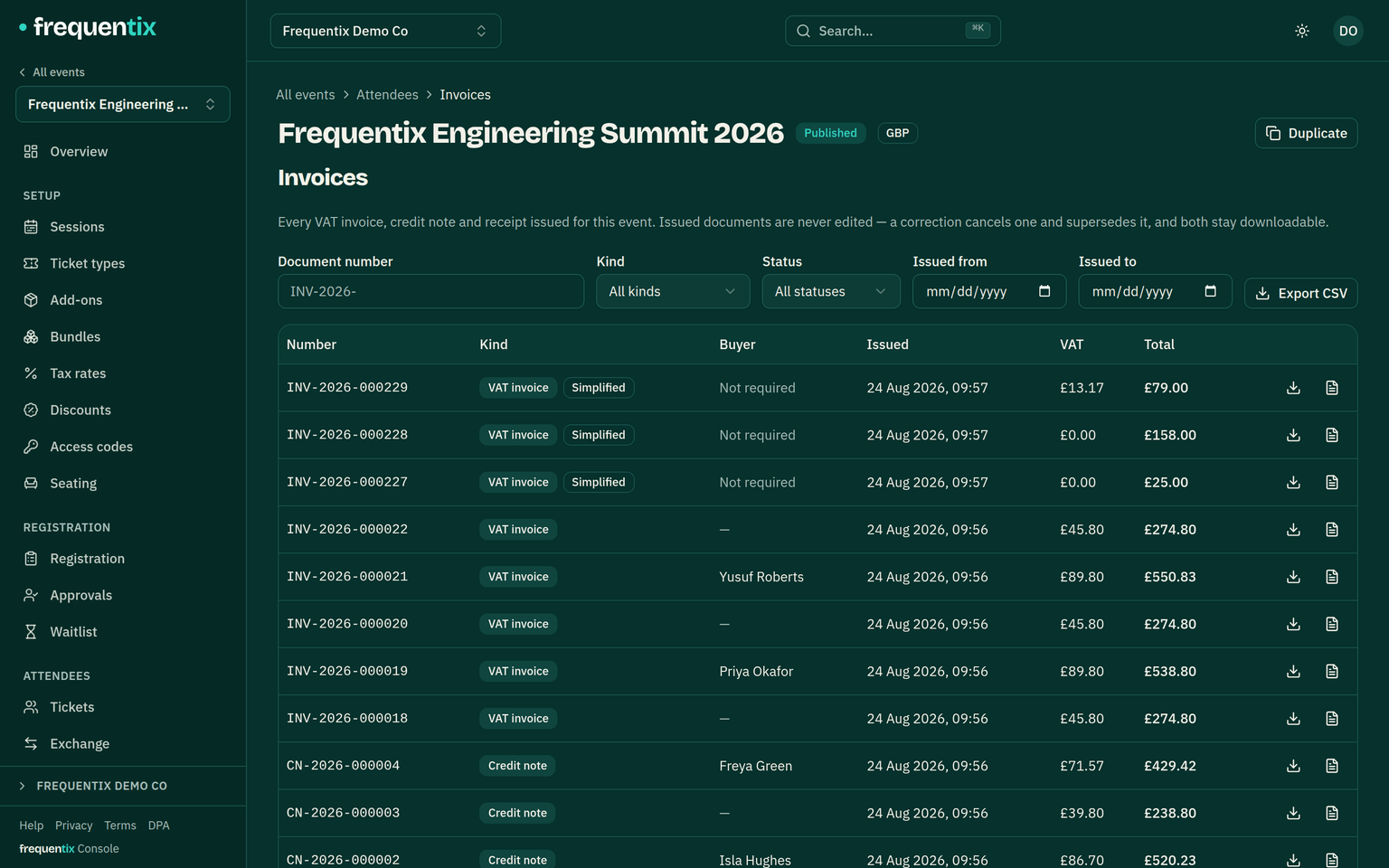
- Numbering is gapless and sequential per organisation, with an optional yearly reset — what an accountant or an inspector expects. Each kind runs its own series — payment requests included, so a pro-forma never interrupts the invoice sequence.
- Each event has an Invoices ledger with CSV export; the order record is the only place a document is issued or reissued.
- Issued documents survive even a GDPR erasure — tax law requires six years of records, and erasure respects that.